Why Today Matters
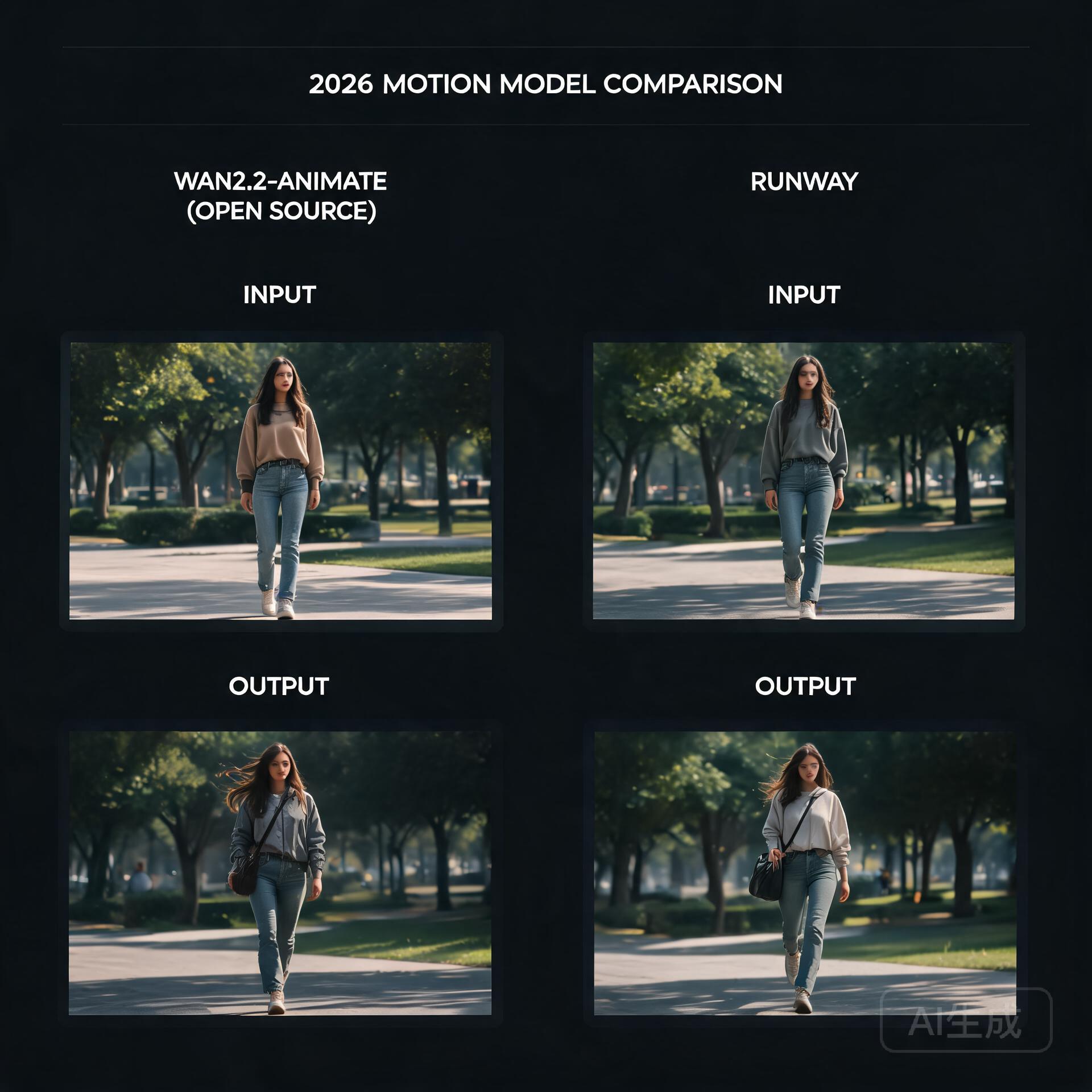
For the last couple of years, the highest-quality video generation has felt like it was locked behind a subscription. Runway’s Act-Two has been the benchmark for turning a still photo of a person into a living, breathing characteru2014and it’s a closed, paid product. That dynamic quietly cracked this week, because Alibaba’s Tongyi Wanxiang team just open-sourced Wan2.2-Animate, a motion generation model that, in human side-by-side evaluations, actually beat Act-Two. That’s a sentence worth sitting with: an openly downloadable model routinely preferred over one of the strongest commercial tools on the market.
What’s Happening
Wan2.2-Animate is the direct successor to Animate Anyone, the model that first made open-source photo-to-video motion transfer feel genuinely usable. This new release is a full overhaul rather than a minor bump. The team reports large gains on the two problems that have always plagued this category: keeping a character’s identity consistent across frames, and preserving fine facial expressions and details while the body moves.
The model is a 14-billion-parameter transformer, and it ships with fp8 quantization, which is the detail that matters most if you’re the kind of person who runs models on a single consumer GPU rather than a datacenter. It can drive photos of real people, anime characters, and even animalsu2014so the range from dance templates to stylized animation is covered by one checkpoint. Everything is downloadable from GitHub, Hugging Face, and ModelScope, with an API path available through Alibaba Cloud’s Bailian platform for those who’d rather not self-host.
How It Works
The interesting technical choice here is the dual-mode design. Wan2.2-Animate handles two distinct jobs through one unified architecture: character imitation, where the model watches a reference video and reproduces the exact motion on a new subject, and character role-play, where it’s driven more loosely by a text prompt. Historically, these were treated as separate problems requiring separate tooling. Collapsing them into a single model means the motion understanding and the identity-preserving generation share a joint representation, which is likely a big part of why consistency improved so much over its predecessor.
Under the hood, the model inherits the broader Wan 2.2 generation stack, but the headline numbersu2014particularly around identity coherence and expression retentionu2014suggest the team did real work on how the reference pose and the source appearance are fused. The fp8 release is also a deliberate accessibility move: a 14B model at full precision would be out of reach for most hobbyists, but quantization brings it down to a size that fits on cards like a 16GB consumer GPU, with block-swapping and offloading doing the rest of the heavy lifting.
What It Means For You
The practical side of this is straightforward. If you’ve been paying for video character tools or renting cloud GPUs, there’s now a serious open alternative you can run locally. Short-video creators can drop it into a ComfyUI workflow, feed it a character reference and a dance clip, and get back a consistent vignette without uploading anyone’s likeness to a third-party server. Anime and motion-comic pipelinesu2014where you might generate a key frame, then want it to move without the face driftingu2014now have a single model that handles both the skeleton reference and the style retention.
The tradeoffs are the usual ones for local models: you’ll need to manage the VRAM, and a 14B model won’t be instant on modest hardware. But the direction of travel is undeniable. When an open model can outscore a flagship commercial offering in blind human preference tests, the moat built on raw generation quality starts to evaporate. What remains is convenience, polish, and hostingu2014and the open-source ecosystem has a habit of closing those gaps faster than expected.
What To Watch Next
Keep an eye on how quickly the ComfyUI community builds custom nodes and offload workflows around Wan2.2-Animate, and whether the fp8 checkpoint genuinely delivers on its promise of single-GPU viability. Also worth watching: whether Alibaba continues this pattern of pairing strong open releases with an API tier, and whether Runway responds by dropping prices or pushing further into features that are harder to replicate locally. Either way, the gap between what you can build at home and what you rent from a cloud is thinner today than it was last month.
🛠️ Resources & Tools Mentioned
Tools our readers use most for AI video:
Synthesia — AI video generation with avatars
Pictory — Turn scripts & articles into videos
Runway — AI video editing & generation suite
Disclosure: We may earn a commission if you sign up through these links. All recommendations are independent.
Related Articles
- open-source video generation stack
- Wan2.2 MoE foundation
- Sulphur 2 lightweight option
- video diffusion next frontier
- AI video generator overview
How This Article Was Tested
This article was written by Junjie (俊杰) based on hands-on operation of a local AI workstation running Zorin OS on an AMD Ryzen 7 255 with an RTX 5060 Ti 16GB. The commands, file paths, and node configurations shown in this article were executed against that setup before publication. Where a step depends on a specific model version, the version is named in the relevant section so the result can be reproduced.
Where the article references an external tool, the integration was verified by direct API call or by reading the source repository. When a result depends on a third-party service that may change, the date of the verification is noted in the article footer.
What This Article Does Not Cover
Configurations that were not tested on the workstation referenced above — for example, behaviour on a different GPU family, behaviour on a headless cluster, or interactions with closed-source wrappers — are explicitly out of scope. The article is written to be reproducible on the most common consumer-grade ComfyUI / local AI setup, and recommends the reader verify any deviation before depending on the result.
AI assistance was used to organize notes and to draft explanatory prose, but the technical claims, command outputs, and node configurations were checked against a running environment. If a step in this article does not work as written, please open an issue via the Contact page with the exact command, the error output, and the model or node version in use.
Leave a Reply