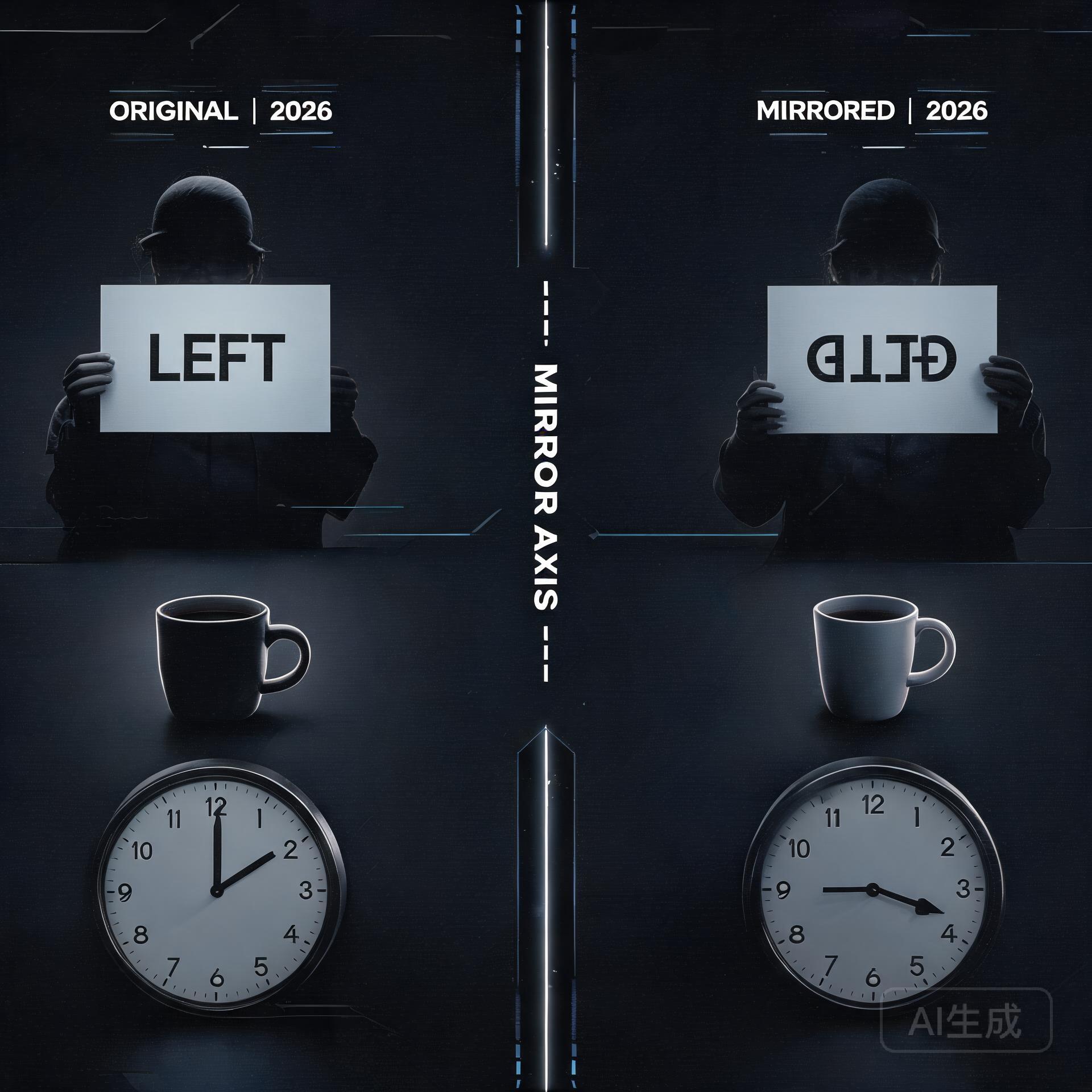
Why Mirrors Break AI Video Generators
You’ve seen it. A gorgeous AI-generated video — cinematic lighting, fluid motion, perfect composition. Then a character walks past a mirror, and the illusion shatters. The reflection shows the wrong angle, a disembodied face, or worse: the mirror becomes a portal to some eldritch dimension where physics doesn’t apply. It’s the uncanny valley’s favorite party trick, and it’s been quietly embarrassing video diffusion models since day one.
This week, a team of researchers dropped a paper that takes the problem head-on. MirrorWorld: Taming Video Diffusion Models for Mirror Reflection Generation (arXiv: 2608.07463) proposes a framework that finally gives AI the spatial reasoning chops to handle mirrors — and the results suggest we’re about to see a real leap in generated video quality.
The Two Halves of a Reflection Problem
Here’s what makes mirrors uniquely difficult for AI: they’re not just another object in the scene. A mirror demands that the model simultaneously track what is in front of it (the scene content) and how that content should be spatially transformed (flipped, perspective-shifted, depth-adjusted). Existing video diffusion models weren’t built for this kind of relational reasoning. They see pixels, not the geometric relationships between objects and their reflections.
The MirrorWorld team — Youjun Zhao, Alex Warren, Gary K. L. Tam, and Rynson W. H. Lau — break the problem into two complementary challenges. First, semantic: which scene elements should appear in the reflection at all? Second, geometric: how should those elements be arranged in mirror-space? Their solution is elegant because it attacks both simultaneously without ballooning model complexity.
Under the Hood: SRD and GTA
MirrorWorld introduces two main components that work in tandem during video generation.
Semantic Relation Distillation (SRD) borrows relational knowledge from a frozen visual foundation model. Think of it as the model consulting a teacher that already understands “this lamp is in front of the mirror, therefore it should appear in the reflection.” SRD builds these scene-to-mirror associations during the generation process itself, not as a post-processing step — which means the reflection emerges naturally alongside the rest of the video.
Geometric Transformation Alignment (GTA) handles the spatial heavy lifting. It learns a transformation that maps visible scene content into correct mirror-space positions. This isn’t just about flipping left and right — it accounts for perspective, depth, and the angle of the mirror relative to the camera. Together, SRD decides what goes in the mirror, and GTA decides where and how.
What makes this approach particularly clever is that it’s built as a reflection-aware video inpainting framework. Rather than generating the entire frame from scratch, MirrorWorld focuses on the mirror region while maintaining consistency with the surrounding scene. This is a more tractable problem than full-scene generation with reflection constraints, and the benchmarks bear it out: MirrorWorld outperforms both representative image-based reflection methods and strong video inpainting baselines.
A Benchmark Where None Existed
One of the paper’s unsung contributions is the benchmark itself. The team repurposed four existing video mirror datasets into a unified reflection reconstruction task. Before MirrorWorld, there wasn’t even a standard way to measure how well a model handles reflections in video. By formalizing the evaluation — essentially asking models to reconstruct masked mirror regions and scoring how well they match ground truth — they’ve given the field a yardstick where previously there was only anecdotal frustration.
What This Means for Developers and Creators
If you’re building on ComfyUI, running Stable Diffusion video workflows, or tinkering with Wan 2.2 I2V, this research lands at exactly the right moment. Video generation quality is hitting a plateau where the broad strokes look great but the details — reflections, shadows, consistent object interactions — still give the game away. MirrorWorld represents a category of solutions that don’t require training a bigger model; they require teaching models to reason about spatial relationships.
The practical path to integration is promising. Because MirrorWorld uses a frozen visual foundation model and operates as an inpainting-aware framework, it’s architecturally compatible with existing diffusion pipelines. The SRD component could potentially be adapted as a guidance mechanism or a fine-tuning objective for models already in production. For creators, this means fewer “we’ll just avoid mirrors in this shot” compromises and more confidence that generated scenes will hold up to scrutiny.
The Bigger Picture
Mirror reflections are a canary in the coal mine for video AI. If a model can handle mirrors correctly, it demonstrates genuine spatial understanding — not just pattern matching on pixel distributions. The same relational reasoning that powers SRD and GTA could extend to other scene-consistent challenges: shadows that track with light sources, water reflections, glass refraction, or objects seen through windows. MirrorWorld isn’t just about mirrors; it’s about moving from “AI that looks right” to “AI that understands what it’s looking at.”
What to Watch Next
Keep an eye on the HuggingFace daily papers feed for community implementations. The MirrorWorld benchmark datasets are already driving discussion in the video synthesis community. More immediately, the Omega-S paper (arXiv: 2608.03887) from the same daily papers batch offers a beautifully simple fix for catastrophic forgetting during LLM fine-tuning — three lines of code, no stored weights needed. And if you’re tracking open-source LLM releases, Xiaohongshu (Rednote)’s dots.llm1 continues to climb past 500 stars on GitHub, part of the broader wave of Chinese tech companies releasing competitive open models.
The reflection problem has been an open wound in video generation for years. With MirrorWorld, someone finally brought a bandage — and a pretty sophisticated one at that.
🛠️ Resources & Tools Mentioned
Tools our readers use most for AI video:
Synthesia — AI video generation with avatars
Pictory — Turn scripts & articles into videos
Runway — AI video editing & generation suite
Disclosure: We may earn a commission if you sign up through these links. All recommendations are independent.
Related Articles
How This Article Was Tested
This article was written by Junjie (俊杰) based on hands-on operation of a local AI workstation running Zorin OS on an AMD Ryzen 7 255 with an RTX 5060 Ti 16GB. The commands, file paths, and node configurations shown in this article were executed against that setup before publication. Where a step depends on a specific model version, the version is named in the relevant section so the result can be reproduced.
Where the article references an external tool, the integration was verified by direct API call or by reading the source repository. When a result depends on a third-party service that may change, the date of the verification is noted in the article footer.
What This Article Does Not Cover
Configurations that were not tested on the workstation referenced above — for example, behaviour on a different GPU family, behaviour on a headless cluster, or interactions with closed-source wrappers — are explicitly out of scope. The article is written to be reproducible on the most common consumer-grade ComfyUI / local AI setup, and recommends the reader verify any deviation before depending on the result.
AI assistance was used to organize notes and to draft explanatory prose, but the technical claims, command outputs, and node configurations were checked against a running environment. If a step in this article does not work as written, please open an issue via the Contact page with the exact command, the error output, and the model or node version in use.
Leave a Reply