The Video Model That Refuses to Be a Closed Toy
For the last two years, the open-source video generation scene has felt like a game of whack-a-mole. A model ships, promises cinema-grade output, and then quietly requires a data-center worth of VRAM to actually run. Creators on consumer hardware — the ComfyUI tinkerers, the single-4090 filmmakers, the hobbyists patching together nodes at 2 a.m. — kept getting left at the door.
Wan2.2, Alibaba’s latest open-source video model, is the strongest signal yet that this dynamic is finally flipping. It is not just another checkpoint drop. It is the first production video generation model built on a Mixture-of-Experts (MoE) architecture — and that architectural choice is exactly what makes it matter for people running models on modest GPUs.
What’s Actually Happening
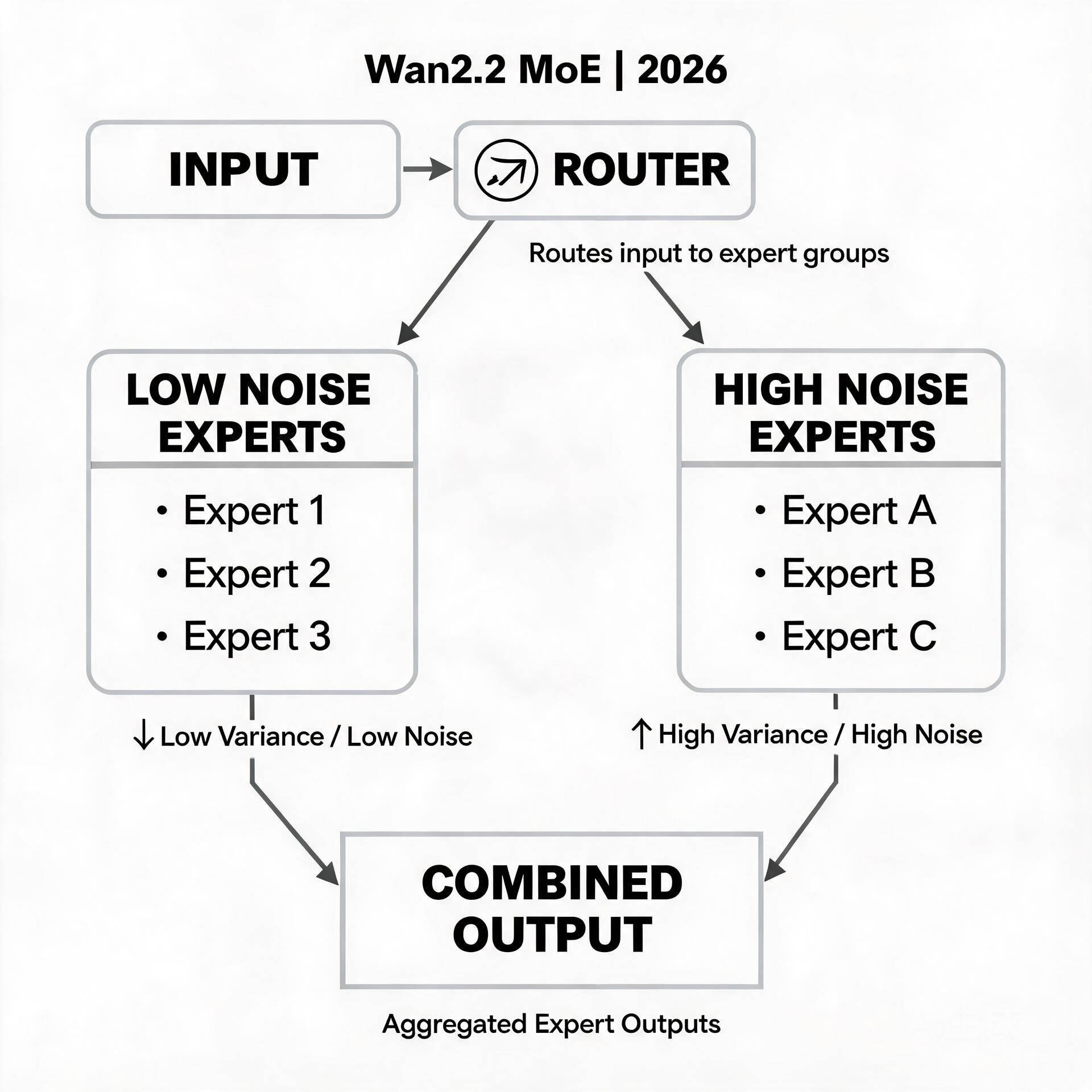
The headline numbers tell part of the story: 27 billion total parameters, with only 14 billion active at any given moment. That gap between “total” and “active” is the whole point of MoE. Instead of a single monolithic network where every parameter fires on every frame, Wan2.2 splits its model into a collection of specialized “expert” subnetworks plus a router that decides which handful of experts any given token actually needs.
Practically, that means the model carries more total capacity — more room to learn motion, texture, and physical plausibility — while only paying the compute cost of a much smaller model at inference time. In early benchmarks and community tests, Wan2.2 delivers a visible jump in video quality and consistency compared to its 2.1 predecessor, while staying in roughly the same resource envelope.
Alibaba released the full family on GitHub, Hugging Face, and ModelScope: text-to-video (T2V), image-to-video (I2V), and a dedicated Animate variant tuned for turning still images and character references into moving footage. The Animate model in particular has generated real buzz, because it targets the use case most creators actually want — bring this one image to life with coherent, controllable motion — rather than the “generate a random clip from text” showcase.
How the MoE Magic Actually Works
If you last thought about video models in terms of diffusion U-Nets or giant transformers, the MoE shift is worth pausing on. In a dense transformer, every layer applies the full weight matrix to every input sequence. In an MoE transformer like Wan2.2, the feed-forward layers — the expensive, parameter-heavy parts — are replaced by a bank of experts, and a lightweight routing network scores each token to pick the top few experts to activate.
Two consequences follow.
First, quality and speed stop being locked together. A dense model that wants to “know more” has to get bigger everywhere, which makes every forward pass slower. An MoE model can grow its total knowledge by adding experts while keeping the per-token active path almost the same size. More expertise, same bill.
Second, the router learns a soft specialization. Over training, different experts quietly develop affinities — one gets good at background motion, another at facial detail, another at lighting transitions. The router learns to dispatch tokens to the right specialists. It’s a division of labor that a dense model can only approximate by being large everywhere, including the parts that aren’t doing much at any given moment.
This is why Wan2.2 matters for the local crowd specifically: the people who experiment with `blocks_to_swap`, who run FP8 quantized checkpoints, who obsess over whether a 16 GB card can squeeze out one more second of footage. MoE gives those exact optimizations more leverage, because offloading or quantizing a layer that only fires for some tokens is far safer than offloading a layer that everything depends on.
What It Means for Developers and Creators
For the ComfyUI community, Wan2.2’s arrival is genuinely practical news rather than distant hype. Workflows for Wan2.1 already exist and are mature; Wan2.2 is largely a drop-in successor, so years of node graphs, LoRA pipelines, and character-driven animatic setups port over with relatively little friction. The models are openly licensed and already mirrored across the major model hubs, which means no gated download dance and no API key to feed.
The Animate variant is where the real opportunity sits. Image-to-video with a reference image has historically been the most finicky corner of open-source video — motion that breaks the source identity, faces that drift, limbs that melt. The community’s early Wan2.2 Animate tests point to noticeably better identity retention and smoother, more intentional motion, which directly translates to fewer re-rolls and more usable seconds of footage per generation session.
There’s an honest caveat to keep in mind. “14B active” is still 14 billion parameters — this is not a model that runs comfortably on an 8 GB card without heavy quantization and BlockSwap tricks. The total 27B footprint also means big checkpoints to store and load. The win here is efficiency relative to comparable *quality*, not magic. A 16 GB card with FP8 weights and aggressive offloading is the realistic sweet spot, and even then, expect to treat Animate as a patient, multi-minute-per-clip workflow rather than an instant one.
Where This Is Heading
The most interesting thing to watch is what MoE unlocks next. If Wan2.2 validates the MoE approach for open video models, expect every major open-source lab to follow — and expect the next wave of models to push the expert-count and specialization angle further, chasing longer clips, finer control, and tighter memory footprints in the same breath.
Equally worth tracking is the tooling race. A model is only as useful as the ecosystem around it, and the speed with which ComfyUI custom nodes, LoRA trainers, and community finetunes adopt Wan2.2 will tell us more about its real ceiling than any benchmark chart. Watch for lightweight Animate LoRAs tuned on specific character styles, and for the first fully local, coherent “image in, short film out” pipelines that don’t need a server rack.
The open-video story has always been a step behind the closed one on polish. Wan2.2 narrows that gap on the axis that matters most to independent creators: the ability to actually run the thing you’re excited about, on hardware you already own. That’s a change worth your attention.
🛠️ Resources & Tools Mentioned
Tools our readers use most for AI tools:
AdCreative.ai — AI-powered ad creative generation
Jasper AI — AI writing platform for marketing copy
Surfer SEO — AI SEO content optimization platform
Disclosure: We may earn a commission if you sign up through these links. All recommendations are independent.
Related Articles
- full open-source video stack
- Animate motion transfer
- Sulphur 2 open-source comparison
- MirrorWorld research
- video generator selection
How This Article Was Tested
This article was written by Junjie (俊杰) based on hands-on operation of a local AI workstation running Zorin OS on an AMD Ryzen 7 255 with an RTX 5060 Ti 16GB. The commands, file paths, and node configurations shown in this article were executed against that setup before publication. Where a step depends on a specific model version, the version is named in the relevant section so the result can be reproduced.
Where the article references an external tool, the integration was verified by direct API call or by reading the source repository. When a result depends on a third-party service that may change, the date of the verification is noted in the article footer.
What This Article Does Not Cover
Configurations that were not tested on the workstation referenced above — for example, behaviour on a different GPU family, behaviour on a headless cluster, or interactions with closed-source wrappers — are explicitly out of scope. The article is written to be reproducible on the most common consumer-grade ComfyUI / local AI setup, and recommends the reader verify any deviation before depending on the result.
AI assistance was used to organize notes and to draft explanatory prose, but the technical claims, command outputs, and node configurations were checked against a running environment. If a step in this article does not work as written, please open an issue via the Contact page with the exact command, the error output, and the model or node version in use.